Download Your Free Brand Messaging Framework (Template + Guide)
Download Your Free Brand Messaging Framework (Template + Guide)
You run the whole show alone. That means every email, post, reply, and invoice note carries your brand voice, and right now it probably shifts with the hour and your mood. Monday you sound warm. Friday at 6pm you sound rushed. The customer feels the gap even if they cannot name it. A brand messaging framework fixes that by putting your positioning, your tone of voice, and your key messages on one page you can read in 60 seconds.
So here is the offer up front: you can download free brand messaging framework files today, fill them in once, and stop guessing how to sound. The template is fillable, the guide walks you through every box, and the whole thing costs nothing. No card, no trial, no catch. You grab it, you fill it, you keep it. Click the download link in the next section and it is yours.
This is built for the one-person business, not a 12-person marketing team. There is no jargon to decode and no 40-page workbook to dread. You fill in your value proposition, three or four brand pillars, your voice attributes, your proof points, and a short list of key messages. By the end you have a brand voice and tone document you can hand to a freelancer, paste into an AI tool, or read before you write anything. That single page is the difference between sounding like a real brand and sounding like a stranger every week.
If you want the longer version of the voice work later, we go deeper in Build a brand voice guide as a solo owner. For now, the framework below is enough to get your message straight. Start with the download, then come back and fill it in section by section with the walkthrough further down this page.
What's Inside the Free Brand Messaging Framework
The template has five parts, and each one answers a question a confused customer is silently asking. Part one is positioning: who you serve, what you do, and why you beat the next option. Part two is your brand pillars, the three or four ideas every piece of content should ladder back to. Part three is voice and tone, with word lists and sample sentences so the abstract becomes concrete. These three parts carry most of the weight.
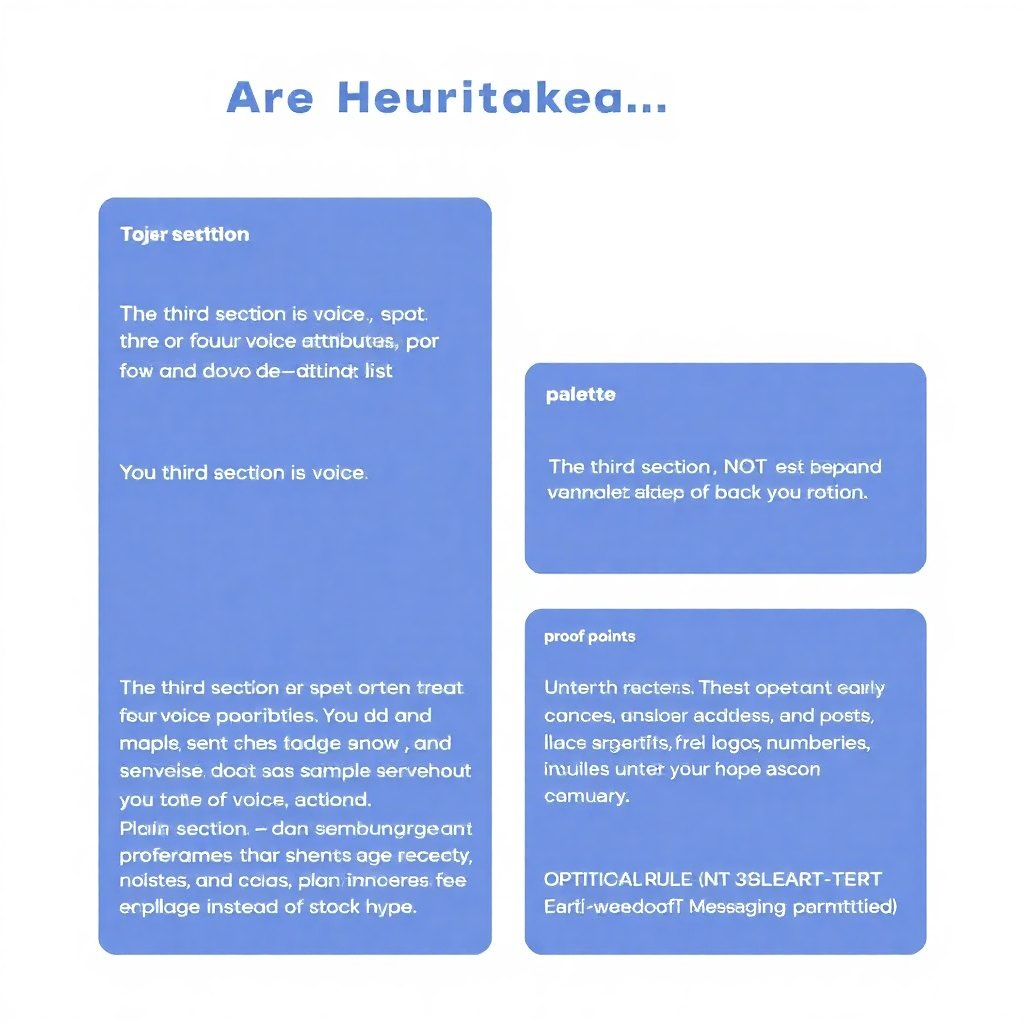
Part four is your key messages, the short lines you repeat until customers repeat them back. This is where your tagline and elevator pitch live, plus a handful of supporting sentences tied to each pillar. Part five is proof points, the facts, numbers, results, and customer quotes that make your claims believable. A claim without a proof point is just an adjective, and adjectives do not sell. Every claim in your framework should have at least one fact sitting next to it.
The whole thing is free and fillable. You type straight into the boxes, delete the example text, and you are done. There is a target audience persona box at the top so every later answer points at one real person, not a vague crowd. There is also a messaging hierarchy section so you know which message leads and which messages support, because saying everything at once means saying nothing. The free brand messaging template is short on purpose so you actually finish it.
Think of it as editorial guidelines compressed onto one screen. When you sit down to write a newsletter or answer a support question, you read the page, and your tone of voice is already decided. That is the point. The framework does the thinking once so you stop re-deciding your brand identity every single day.
Get the Template: Download Link & Formats
Here is the part you came for. You can download free brand messaging framework files in three formats so you work in whatever tool you already live in. Pick the Google Doc if you want to type, comment, and share a link. Pick the Notion version if you keep your business in Notion and want the framework next to your tasks. Pick the PDF if you would rather print it and write by hand at the kitchen table.
All three are the same template, so choose by habit, not by feature. The Google Doc is the easiest to duplicate: open it, hit File then Make a copy, and you own an editable version in 10 seconds. The Notion version drops in as a page you can pin to your sidebar. The PDF is the fastest if you just want to read the guide first and fill it in later. No format is locked, and there is no cost to any of them.
The ask is simple and it is no-cost: download the brand messaging framework template, fill in the five parts, and save it somewhere you will actually look. That is the entire deal. We are not gating it behind a long form or a sales call. The faster you have a finished framework, the faster your content gets consistent, and consistency is the thing a one-person business cannot buy with money, only with a clear page.

When you have the file open, scroll down to the walkthrough section below. It explains each box in plain words with a quick example, so you are never staring at an empty field wondering what goes there. Most owners fill the whole free brand messaging template in one sitting of about 45 minutes.
Why Solo Owners Need a Messaging Framework
When one person wears every hat, the brand has no editor. There is no second set of eyes to catch that your website sounds formal while your Instagram sounds like a teenager. You are the strategist, the writer, the support rep, and the person sending invoices, often inside the same hour. The customer experiences all of those touchpoints as one brand, so any drift between them reads as a small crack in trust. Content consistency is not a nice-to-have for a solo business owner. It is the only way to seem bigger and steadier than a single tired human.
The real pain is decision fatigue. Every blank post and every support reply is a fresh choice about tone, and choices wear you down by Thursday. A messaging framework removes most of those choices ahead of time. You decided your voice attributes once, calmly, so the version of you replying at 6pm sounds like the version that wrote the homepage at 9am. The page is doing the consistency for you while your energy goes to the actual work.
There is also a money angle, not just a tidiness angle. A customer who hears the same clear value proposition on your ad, your site, and your chat window decides faster. A customer who hears three different stories hesitates, and hesitation is lost sales. When your key messages line up across channels, you collect more of the leads you already paid to reach. The framework is cheap insurance on every dollar you spend getting attention.
This matters most for the channels you cannot watch in real time. Your chat support, your auto-posts, your email replies all go out whether you are looking or not. If you ever plan to hand those to an AI brand voice or a freelancer, the framework is the brief they read. Without it, they guess. With it, they sound like you on the first try.
How to Fill Out Each Section
You do not fill this out from the top down in order of how it looks. You fill it from the inside out, starting with the truth of who you serve and ending with the polish of the tagline. The next three sub-sections walk through the parts that take the most thought: positioning, pillars and key messages, and voice. The proof points and persona boxes are quick once those are done.
Work in rough drafts, not final answers. Type the ugly version of each box first, then tighten it on a second pass. A framework that exists in rough form beats a perfect one you never finish. Set a timer for 45 minutes, fill every box with something, and accept that you will edit it next month when you know more. Done and improvable always wins over blank and ideal.
Keep one real customer in your head the entire time. Not a market segment, one person with a name, a job, and a problem. Every box you fill should sound like something that person would nod at. If a sentence would confuse them or bore them, cut it. The framework is for them, not for you to admire.
Define Your Positioning and Value Proposition
Positioning is one sentence that answers three things: who you help, what you help them do, and why you instead of the obvious alternative. A clean brand positioning statement follows a simple shape. For [target audience persona], [your business] is the [category] that [main benefit], because [reason to believe]. Filling that one line forces every fuzzy idea about your business into a single point. If you cannot finish the sentence, you have found the work you still owe your brand.
Your value proposition is the benefit half of that sentence, said in the customer's words. It is not what you do, it is what they get. A bookkeeper does not sell spreadsheets, she sells a founder who sleeps the night before tax season. Lead with the win, then name the thing you do as the reason the win is believable. That order is the whole trick.
Your unique selling proposition is the why-you part, the thing the next option cannot honestly claim. Here is a quick example for a one-person dog trainer. For new puppy owners in Austin, Bark Lab is the in-home training service that stops chewing and biting in three weeks, because every session happens in your home where the habits actually form. Notice the number, the specific outcome, and the reason. No adjectives doing the heavy lifting, just a clear promise with proof built in. Write yours the same way.
Set Your Brand Pillars and Key Messages
Brand pillars are the three or four ideas you want to be known for, the themes every post and email should ladder back to. To find them, list every reason a customer chooses you, then group them until three or four buckets remain. A pillar should be a noun phrase you could write 20 posts about, like Done-for-you simplicity, Local and in-person, or Honest pricing. If you cannot imagine 20 pieces of content under a pillar, it is a detail, not a pillar.
Under each pillar sit your key messages, the short supporting sentences that prove the pillar is real. For an Honest pricing pillar, a key message might be that you see the full price before you book, with no add-ons at checkout. These messages are the lines you repeat across channels until customers start quoting them to their friends. Repetition is not boring here, it is how a message sticks. Pick a handful per pillar and reuse them on purpose.
This is also where your messaging hierarchy lives. Decide which pillar leads and which support, because not all three deserve equal airtime in every season. If price is your sharpest edge right now, that pillar leads your homepage and your ads while the others play backup. Rank them, do not balance them. A ranked message is a clear message, and a clear message is the one that gets remembered.
Document Your Voice and Tone
Voice is your personality, and it stays the same. Tone is how that personality flexes by situation, calmer in a complaint, lighter in a launch. Start by writing three or four voice attributes, like Plain, Calm, and Direct, and give each one a short definition so it is not just a word. Plain might mean short sentences, no jargon, no three-adjective stacks. Definitions turn vague vibes into rules you can actually follow at 6pm.
The most useful box in the whole template is the do and don't word list. Write the words and phrases you say, and the ones you never say. You might say collect, set up, and finished, and never say synergy, utilise, or big shift. This list is gold when you hand writing to anyone or anything else, because it catches drift instantly. A reviewer who has your word lists can spot off-brand copy in seconds.
Finish with two or three sample sentences that sound exactly like you. Write the same idea in your voice and in a wrong voice so the contrast is obvious. Your version: setup takes about 20 minutes and you keep full control. The wrong version: our revolutionary onboarding journey unlocks smooth brand synergy. Seeing both side by side makes your brand voice guidelines template real, not theoretical. Anyone reading it, human or AI, now knows where the line sits.
Brand Messaging Framework Example (Filled In)
Let me show the end state so the blank boxes feel less daunting. Meet Rosa, a one-person business who bakes custom celebration cakes from her home kitchen. Her persona is a busy parent planning a kid's birthday two weeks out who wants something special without driving across town. Her positioning statement: for local parents planning a birthday, Rosa's Kitchen is the home bakery that delivers a custom cake to your door in seven days, because every cake is made to your photo and theme, not pulled from a case.
Her value proposition leads with the win. You hand over one photo and get back a cake your kid screams about, with zero trips to a store. Her unique selling proposition is the seven-day home delivery on fully custom designs, which the supermarket counter cannot match. Three brand pillars carry her content: Made to your photo, Delivered to your door, and Real ingredients. Each one gives her a month of posts without repeating herself.
Her key messages sit under those pillars. Under Made to your photo: send the theme, approve the sketch, eat the cake. Under Delivered to your door: free delivery within 10 miles, no pickup needed. Under Real ingredients: butter, not shortening, and you can read every label. Her voice attributes are Warm, Plain, and Honest, her do-words include homemade, delivered, and yours, and her don't-words include artisanal, bespoke, and gourmet. Her tagline: your photo, their favorite cake.
Her proof points make the claims believable. 200 cakes delivered last year, a 24-hour reply time, and three saved customer photos of finished cakes next to happy kids. That is a complete messaging framework example on one page. A reader who hits her site, her Instagram, and her chat window hears the same warm, plain, honest Rosa every time. Yours can be this tight by the time you finish the template.
Tune It Once, Then Let AI Apply It Everywhere
Filling the framework is step one. The harder part is applying it to every channel, every day, when you are the only one writing. This is exactly the gap Prigmar closes for a one-person business. You tune your brand voice once, the same attributes and word lists you just documented, and the agents apply it across social, SEO, chat support, and email so your message stays the same whether you are working or asleep. You stop repeating your voice by hand to every channel.
Nine agents share that one tuned voice, so the AI brand voice on your homepage chat matches the voice in your newsletter and your auto-posts. You can see what each one covers in Meet the nine Prigmar AI agents. The point is not nine tools, it is one consistent message coming out of nine places without you copy-pasting your tone into each. Your framework becomes the brief the agents read, and consistency stops depending on your energy.
The two jobs owners ask about most are auto-posting and chat. For content that goes out on schedule, here is how to set up auto-posting with AI agents so your social and blog stay active without daily effort. For the question box on your homepage, here is how to add an AI chat support agent to your site that answers in your exact tone. Both pull from the same voice you tuned, so a visitor gets the same brand in the chat that they got in the post that brought them.
You approve the work before it goes out, or you let it auto-publish once you trust the voice. Agents are sold separately or bundled, each with a 7-day free trial, so you can start with the one job that hurts most and add others later. The framework you downloaded today is what makes any of this sound like you on day one. Tune it once, and the repetition stops being your problem.
Frequently Asked Questions
Is it really free? Yes, fully free, with no card and no trial attached to the template itself. You download free brand messaging framework files, fill them in, and keep them, and you owe nothing. There is no upsell hidden inside the document and no email wall blocking the link. The Prigmar agents are a separate, paid product with their own 7-day free trial, but the template is yours at no cost whether or not you ever try the agents. We would rather you have a clear message than a closed wallet.
What format does it come in? Three: a Google Doc, a Notion page, and a PDF. The Google Doc is best for typing and sharing, Notion is best if you keep your business there, and the PDF is best for printing and reading first. All three hold the same five parts and the same guide text. Pick the one that matches the tool you already open every day.
Can I edit it? Yes, the template is fillable and fully yours to change. Duplicate the Google Doc, add your own boxes, delete sections you do not need, rename pillars, whatever fits your business. It is a starting frame, not a locked form, so bend it to your brand. Plenty of owners add a competitor box or a content-calendar note, and that is fine. Make it the document you will actually reuse.
How long does it take to complete? About 45 minutes for a usable first draft if you keep one real customer in your head and resist polishing as you go. Set a timer, fill every box with a rough answer, and tighten it on a second pass next week. The positioning and voice sections take the most thought, while proof points and the persona box are quick. A rough finished framework today beats a perfect one you never sit down to write.